Learn French BLOG
l'amour (m) =
love.
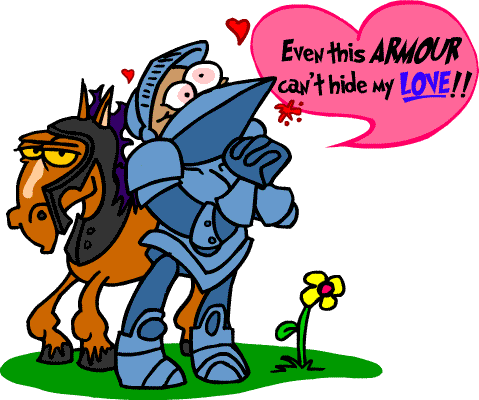
Imagine a knight (m) in shining ARMOUR is in love!
Mylène Farmer, née le 12 septembre 1961 est une chanteuse française très connu dans le monde francophone ainsi qu'en Europe de l'Est, notamment en Russie.
Elle s'est construit un univers très sombre et ses chansons traitent de thèmes tels que l'amour, la mort, etc.
Ses concerts sont dignes des plus grands shows américains et elle détient plusieurs records, comme celui d'artiste ayant le plus grand nombre de Disques de Diamant.
Certains de ses clips sont de véritables courts métrages (ils peuvent durer presque 20 minutes).
Elle a enregistré avec des artistes mondialement connus tels que Seal (Les Mots) ou Moby (Slipping Away).
------
Mylène Farmer, born on September 12th 1961 is a French singer very famous in French-speaking countries and in the Eastern Europe, notably in Russia.
She has built a very sombre universe and her songs deal with subjects such as love, death, etc.
Her concerts are some of the biggest shows in America and she holds numerous records, including the artist with the highest number of Diamond Records.
Some of her videoclips are like short films (some of them last nearly 20 minutes). She recorded with worldwide famous singers such as Seal (Les Mots) or Moby (Slipping Away).
laisser tomber = to drop (lit. to let fall)
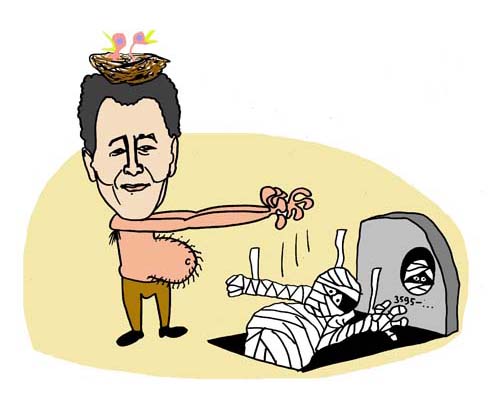
Imagine LAZY TOM drops the Egyptian mummy in the TOMB, AYE!
François-René de Chateaubriand, né le 4 septembre 1768, est un écrivain français.
Il est considéré comme le père du romantisme français. En effet, il introduisit en premier l’idée de “vague des passions”, un thème repris couramment par les auteurs romantiques.
Il est mort à Paris le 4 juillet 1848. Après sa mort fut publiée son autobiographie, Mémoires d’outre-tombe.
---------
François-René de Chateaubriand, born on September 4th 1768, was a French writer.
He is considered to be the father of French romanticism. Indeed, he first introduced the idea of “wave of passions”, a theme which was often used by the Romantic authors.
He died in Paris on July 4th 1848. After his death his autobiography was published: Memoirs from Beyond the Grave.
le beau-père = stepfather, father-in-law.
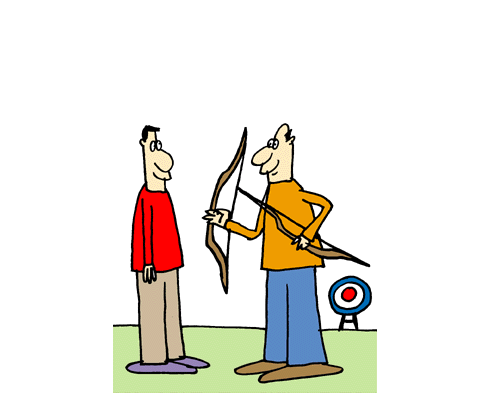
Imagine your father-in-law or step-father (m) with a BOW PAIR, as in a PAIR of BOWS for archery.
-------------
Charles Beaudelaire, poète français, est né le 9 avril 1821 et est mort le 31 août 1867.
Dans son adolescence, alors qu'il était très turbulent, sa mère et son beau-père décident de l'envoyer en voyage dans les Indes. L'exotisme de ce voyage l'a beaucoup inspiré pour ses poèmes.
Charles Beaudelaire a révolutionné la poèsie : pour lui, le "beau" est plus important que le réalisme.
La première édition des Fleurs du Mal lui a valu une amende et il a été obligé d’en retirer certains poèmes, jugés comme allant à l’encontre des moeurs de l’époque.
-------------
Charles Beaudelaire, a French poet, was born on April 9th 1821 and died on August 31st 1867.
During his adolescence, while he was very unruly, his mother and his stepfather decided to send him to the Indies.
The exoticism of his travel inspired him a lot for his poems. Charles Beaudelaire revolutionized poetry: for him, beauty was more important than realism.
The first edition of The Flowers of Evil cost him a fine and he had to remove some of the poems, said to be against the moral standards of the time.
élargir = to enlarge, to expand, to increase, to widen
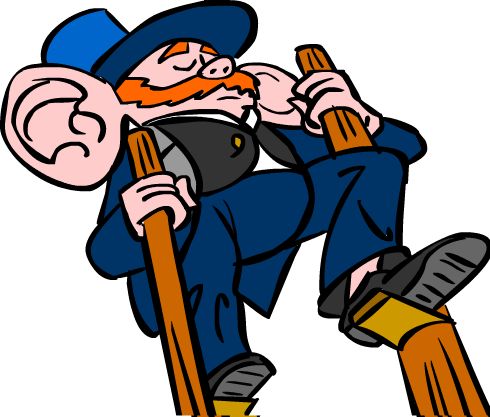
Imagine you enlarge the size of the LARGE EAR!
Subscribe to Daily French Lesson - a new conjugated verb every day
le 19 juin 2012
L'acteur français Jean Dujardin (maintenant aussi connu sous le nom de John Fromthegarden) est né le 19 juin 1972 près de Paris.
Il y a quelques mois, il a gagné l'Oscar du meilleur acteur pour son rôle dans The Artist.
Il est le premier acteur français à recevoir cette récompense.
----
French actor Jean Dujardin (now also known as John “From-the-garden”) was born on June 19th 1972, close to Paris.
A couple of months ago he won the Oscar for Best Actor for his role in The Artist.
He is the first French male actor to receive this award.
l'épreuve (f) = test, examination; ordeal
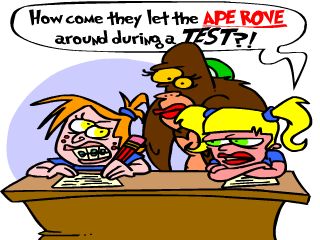
Imagine during a school test you saw a female (f) APE ROVE
around to monitor any girls (f) cheating.
Aujourd'hui est un jour important pour les élèves de Terminale.
En effet, les 3 principales filiéres (littéraire, scientifique et économique) vont passer leur première
épreuve du Baccalauréat : la philosophie.
Ils auront entre 7 et 10
épreuves pendant la semaine (histoire, maths, espagnol, ...). Mais ils devront attendre jusqu'à début juillet pour avoir leurs résultats !
Bonne chance!
--------
Today is a very important day for the students in the Final Year (13th grade).
Indeed, the three main “filieres” (streams) (literature, science and economics) will sit their first
exam for the Baccalaureat (A-level): philosophy.
They will sit between 7 and 10
exams during the week (history, maths, Spanish ...). But they have to wait until the beginning of July to receive their results!
Good luck!
entendre = to understand, to hear, to mean.
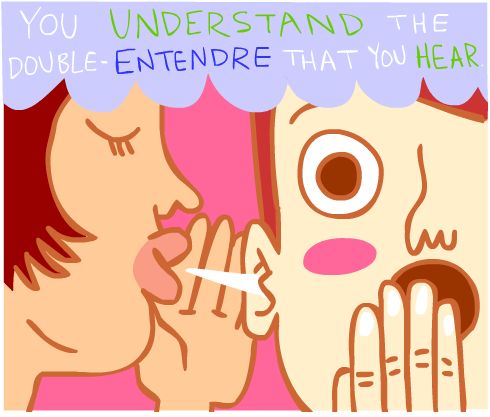
Imagine you understand the double-ENTENDRE that you hear!
---------
Jeanne d'Arc - Joan of Arc
Jeanne d'Arc, aussi appelée “la Pucelle d'Orléans”, fut un personnage important de la Guerre de Cent Ans qui opposa le Royaume de France à celui d'Angleterre.
Simple paysanne, elle prétendit avoir
entendu des voix lui demandant d'aider la France à se débarasser de ses envahisseurs. Elle mène plusieurs batailles puis est capturée par les Bourguignons et revendue aux Anglais.
Le 30 mai 1431, elle est brûlée vive à Rouen. En 1909 et 1920, elle est béatifiée puis canonisée.
---------
Joan of Arc, also called “the Maid of Orléans”, was an important character of the Hundred Years' War between the Kingdom of France and the Kingdom of England.
A simple peasant, she claimed to have
heard voices asking her to help France get rid of their invaders. She led several battles and then was captured by the Burgundians and sold to the English. On May 30th 1431 she was burnt alive in Rouen.
In 1909 and 1920, she was beatified, then canonised.
la Fête des Voisins - Neighbours' Night
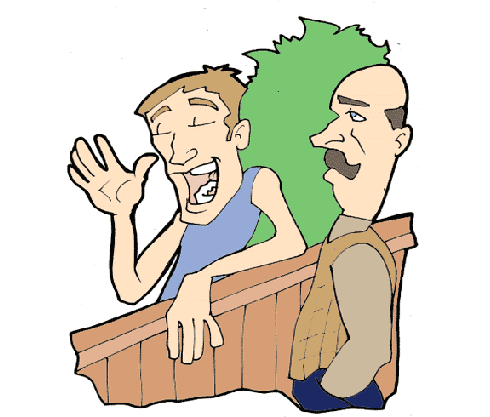 le voisin
 (m) = neighbour
Imagine that your male
neighbour (m) is always
VOICIN’ his opinion to your dad.
----------
Le dernier vendredi de mai se déroule la Fête des
Voisins. A cette occasion,
les voisins se rassemblent dans les rues. Tout le monde apporte une salade, un gâteau, des chips ou une bouteille et ils passent un agréable moment ensemble. C'est l'occasion d’apprendre à se connaitre et de laisser les tensions de côté. En 2012, elle a lieu le 25 mai.
-------
On the last Friday of May the “Fete des Voisins” (
Neighbours' Night) takes place. On this occasion,
neighbours gather in the street. Everyone brings a salad or a cake or crisps or drinks and they spend time together. This is an opportunity to get to know each other and to set aside tensions. In 2012, it is happening on May 25th.
Le 16-27 mai 2012, c'est le 65ème Festival de Cannes
A cette occasion, découvrons 5 films français incontournables.
Commençons avec Intouchables, le plus gros succès de l'année 2011 au cinéma en France. Ce film s'inspire d'une histoire vraie : un homme tétraplégique décide d'engager un jeune des bamlieues pour s'occuper de lui. Entre eux naît une grande histoire d'amitié. En France, le film attiré 19 266 115 spectateurs. Le film a aussi séduit en Allemagne, en Suisse, en Belgique, en Autriche, en Italie et en Espagne.
L'acteur Omar Sy a reçu un César pour ce rôle.
-------
May 16-27 2012 is the 65th Cannes Film FestivalFor this occasion, let's find out about 5 must-see French movies.
Let's start with the Intouchables, the biggest success of the year 2011 in French cinema. This movie is inspired by a real story: a quadraplegic man decides to hire a young man from the suburbs to take care of him. A deep friendship grows between them. In France, the movie attracted 19,266,115 spectators. The movie also charmed people in Germany, Switzerland, Belgium, Austria, Italy and Spain.
The actor Omar Sy received a Caesar (French cinema award) for his role.
Beware the French decade is much shorter!
Une decade in French is only 10 days... not 10 years.
Une décennie is ten years.
bâcler - to botch something up, do a rushed job
Bâcler is a common useful verb that refers to a rushed job that is a bit slapdash, botched up.
il a bâclé son ouvrage - he did his work quickly and to a pretty rough standard.
tu and vous
Which French word for you to use when addressing someone.
The best strategy for foreigners is to start off using the vous form and let French people take the initiative in moving on to tu.
Learn all about tu and vous here.
le quatorze juillet - la Fête Nationale
Le 14 juillet c'est la Fête Nationale, il célèbre la prise de la Bastille.
Il est conformément appelé La Fête Nationale et comunément le quatorze juillet.
La prise d'assaut de la forteresse de la bastille a été vu comme un symbole de révolte de la population moderne.
The 14 th July is a national day which celebrates the day that the Bastille in Paris was taken.
It was formally called “The National Celebration” and commonly called “The Fourteenth of July”.
The storming of the Bastille fortress was seen as a symbol of the uprising of the modern nation.
(Wikipedia)
la Coupe du Monde
En 2010 la Coupe du Monde se déroulait en Afrique du Sud du 12 juin au 11 juillet. La finale était entre l'Espagne et la Hollande. L'Espagne remporta 1-0.
The 2010 World Cup was held in South Africa from 11 June to 11 July. The final was between Spain and Holland. Spain won 1-0.
le carnaval tropical
Chaque année à Paris début juillet a lieu le carnaval tropical.
Toutes les îles, colonies de la France sont présentes, tout le monde porte des costumes, des tenues traditionnelles, chante, danse, dans les rues de Paris.
Il ya aussi de bonnes dégustations pour les gourmands!
The Tropical Carnival (or Carnival of the Tropics) takes place every year in Paris at the beginning of July.
All the islands and colonies of France are there (represented), everyone wears costumes, traditional clothing, (they) sing and dance in the streets of Paris.
For food lovers there is also great food to taste.
le carnaval (v) = carnival
porter (v) = to wear; to carry; to bear; to have
la tenue (f) = clothes; (ie) dress
- la tenue de cérémonie (f) = ceremonial dress
- la tenue de travail (f) = working clothes
l'île (f) = island
la colonie = colony
la dégustation = tasting
gourmand (adj) = fond of food
bavarder = to chit-chat, to gossip
bavard / bavarde (adj) (m/f) = talkative, chatty
Il est bavard comme une pie. = Lit. He is talkative/chatty like a magpie. = He'll talk the hind legs off a donkey.
bavarder (v) = to chat, to chatter, to gossip, to blab.
Il bavard comme une fille. = He chats/gossips/blabs like a girl.
le bavardage (m) = chit-chat, gossip, tittle-tattle
le ragot (m) = piece of gossip, usually ill-natured
la commère (m/f) = gossip, busybody, crony
les bavardages de commères (m) = chit-chat, gossip, tittle-tattle
Je m'éprise les bavardages des commères or Je m'éprise les ragots des commères. = I hate the chit-chat of busybodies.
French Football - le foot - Words
Check out lots of French Football Words here.
En ce jour du 12 Juin - On this day the 12th of June
le 12 juin 2008 était la première édition du Festival du film de Dièppe, en Normandie, nord-ouest de la France.
Ce festival récompense les professionnels de films mais également les amateurs, c'est un festival ouvert à tous.
Il eût un grand succès et se tient chaque année en Juin.
The first “edition” of the Dieppe Film Festival was held on the 12th 2008, in Normandy, northwest France.
This festival rewards film professionals as well as amateurs, it's open to all people.
It was a great success and is now held every year in June.
Conversation entre des amis.
Conversation between friends.
Pierre:
J'aimerais tellement qu'on reçoive un prix pour notre film.
I would very much like that for we receive an award for our film.
Clara:
Moi je pense qu'on a tous notre chance mais si aujourdhui on ne gagne pas, ce n'est pas grave, on dois continuer d'avancer.
For me I think that everybody has a chance but if today we don't win, it's not a big deal, we have to keep going forward.
Pierre:
Je t'admire!
I admire you!
Carla:
Je sais! N'oublies pas, tu dois continuer d'avancer.
I know! Don't forget, you have to keep going forward.
(nf) une édition = edition
(nm) un festival = festival
(v) récompenser =to reward
(v) recevoir = to receive
(v) admirer = to admire
(expr) continuer d'avancer = keep going forward
(v) oublier = to forget
(v) savoir = to know
(nm) un prix = an award
(adj) grand = big/great
(v) avancer = to go/move forward
(v) admirer = to admire
En ce jour du 7 Juin
On this day the 7th of June
Le peintre impréssionniste Paul Gaugin est né à Paris en 1848.
Connu grâce à ses célèbres peintures : “Paysannes bretonnes”, “M.Loulou”, “Etude de Nu ou Suzanne cousant”.
On this day in 1848 the French post-impressionist painter Paul Gauguin was born in Paris. He is known thanks to his famous paintings : “Paysannes bretonnes”, “M.Loulou”, “Etude de Nu ou Suzanne cousant”.
(nm) un peintre = a painter (male)
(nf) une peintre = a painter (female)
(nf) une peinture = a painting
(v) peindre = to paint
(vr) se peindre = to paint a self portrait, to paint oneself.
(v) (se) peindre comme ... = to depict (oneself) as ...
grâce à = thanks to
Quick Grammar Lesson
Nouns ending in “s” are in most cases plural. It is not usually pronounced, just written.
Accents like the grave - “è” - change the oral pronounciation of a word.
For example après = after. (Without an accent here -es would not be pronounced at all.)
Oct 5, 2009
Some words that sound like FOOL might FOOL you ... fouleé
Here are a few words that can get confused.
La fouleé means
STRIDE.
Imagine the STRIDE of a female FOOL AYE!
Dans la foulée de means literally 'in the stride of' and translates more like 'on the heels of' in English.
Dans la foulée de son succés beaucoup d'offres sont arrivées.
Following (on the heels of) his/her success lots of offers came in.
But don't confuse the word with fouler... pronounced the same way... and is related to la fouleé
FOULER: Don't let a FOOL TRAMPLE you or TREAD on you.
The verb
fouler means to
TRAMPLE, TREAD, and also to
SPRAIN.
An idiom with fouler is:
ne pas se fouler - he won't strain himself (to get something done).
Michel ne s'est pas foulé pour finir le projet.
Michel did not strain himself to finish the project.
Calling a Spade a Spade
The French idiom for this is more direct:
Il apppelle les choses par leur nom ... , literally he calls things by their name.
Voilà ce que j'appelle pleuvoir! means 'That's what I call rain!' or 'Now that is what I call raining with a vengeance!
Check out more French Proverbs
Imagine a MESH of candle WICKS
La mèche in French has a few meanings, and forms the basis of some nice little idiomatic expressions.
La mèche means:
- wick, as in candle wick,
- fuse, as in the fuse for a bomb, firecracker etc, explosive
- lock of hair, or a tinted steak in hair
- drill bit
To remember the word
la mèche as a wick, imagine actress
MICHELLE Pfeiffer lights a candle
WICK which is shaped like a wire
MESH ...
You can also imagine her lighting a FUSE which is a MESH.
People using the 200 Words a Day! courses know that we use Michelle, as a Gender Trigger, reminding us that in French, la mèche is feminine. MICH-elle even sounds a bit like MESH...
Because she is a famous person this makes recall of the word easier. Famous people are used extensively in our courses to help with such recall of vocab.
To remember the word la mèche as a lock of hair, or streak of hair, we can imagine actress MICHELLE Pfeiffer's locks of hair is like a wire MESH, with streaks in it.
Some expressions using la mèche
Vendre la mèche (literally, to sell the wick) or
brûler la mèche, (literally, to burn the wick)...
...means to reveal a secret...
...
BUT...
Brûler la mèche de deux côtés.
To burn the candle at both ends.
Literally the French say, to burn the wick at both sides.
Daniel aimait brûler la mèche de deux côtés.
Daniel liked to party a lot, liked to burn the candle at both ends.
Être de mèche avec quelqu'un...
...means to be cahoots with someone.
Caroline est de mèche avec Françoise.
Caroline is in cahoots with Françoise.
The useful word, autant
Autant generally means '
as much',
'as - - as'.
There are lots of idiomatic expressions using
autant.
Autant vaut être mordu d'un chien que d'une chienne.
One evil is as bad as the other. Literally this means - It's the same being bitten by a male dog as a by a female dog.
Cela est fini ou autant vaut.
It is as good as finished. It's as good as done.
Il n'a jamais autant plu.
It has never rained as much.
Ne perds pas ta salive. Autant parler á un sourd.
Don't waste your breathe (literally your saliva). You might as well be talking to a deaf person.
Cela m'agace autant que vous!
This annoys me as much as it annoys you.
Silence means consent...
Here's a useful little idiom...
Qui ne dit mot, consent.
Literally this means (He) who does not say a word, consents. In other words, if you keep your mouth shut you are giving consent...
Experimenting for EXPERIENCE - watch these ones for a subtle shift in meaning...
The French verb
expérimenter means the same as it does in English... to try out, to test, to experiment...
...and the word for
an experience is also the same -
une expérience.
and, for example, she can have a lot of experience...
elle a de l'expérience
...or not a lot of experience
elle n'a pas de l'expérience
However, here is one to watch...
someone who is experienced is
expérimenté
... so remember this just remember that, in French, an
experienced person is someone who has done LOTS of EXPERIMENTS. So just imagine a wizened old scientist, who has spent a lifetime doing
experiments, as an experienced sea captain.
Learn French Fast | Learn 101 French Proverbs | Foreign Service Institute FSI French Courses for Diplomats (trained thousands of US Diplomats) | Store - Buy it Here | Learn Spanish Blog - regular tips and updates | Learn German Blog | General Language Learning Blog of the 200 Words a Day! website
Learn French Blog - regular quips and tips for learners of French language.
200 Words a Day! Excelerated Language Learning Software
200 Words a Day! and Exceltra ©Copyright 2004-2023 All Rights Reserved
Learn French Blog.
See the Verb of the Day Fully Conjugated
To see the verb of the day above, with all its conjugations, just click on the picture, and a new window will open. Recite all the conjugations:
- by row - one tense at a time for each pronoun (I, you, he, she, we, they ...)
- by column- one pronoun at a tense by tense
This should take a bit over a minute per row or column.
Do one full table a day and pretty soon you will have nailed all the different verb endings for all the different major tenses of modern spoken French.
You see, we have clustered all loads of verbs with the same patterns of major ENDINGS. So there are several months worth of ER verbs, which are the most common of the French verbs. So if you just do one full verb table a day, you will soon have conquered the patterns. The more times per day that you do the table, the quicker you will progress.
So for those that are serious, here are some ways to speed up the process:
- Think of the times that you have some blocks of THREE-MINUTES.
- PRINT the table off, and do them throughout the day when you get a spare 3 minutes
- Can you think of some ... while on a train, bus, plane, any bits of waiting time, or down time, sitting on the throne is a great one ... when you get up in the morning, before bed, before falling asleep etc, etc.
- Go through the full verb table, aloud, with the printed sheet, and as you improve....
- without your printed sheet.
- Don't forget to review previously learned verb tables, after a day, a week, a month, three months etc as these spaced review opportunities are great, and imperative for memory boosting.
Conjugated French Verb List
|


